
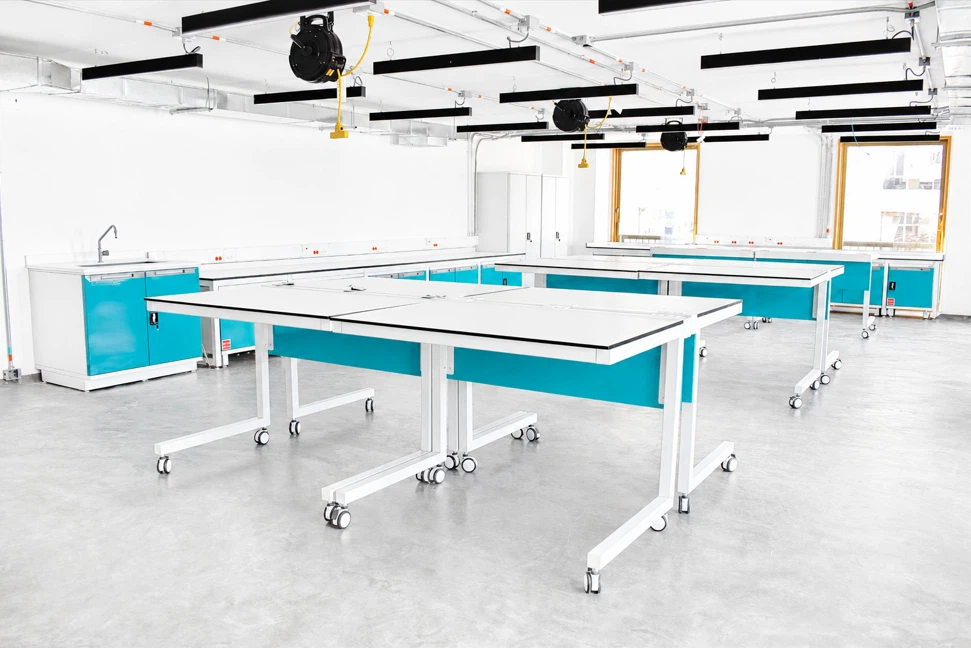
Phenolic Benches: Reliable Chemical Resistance

In This Article, You’ll Learn: how phenolic benches provide reliable chemical resistance for everyday laboratory use, delivering safety, hygiene, and long-term performance without overengineering.

Phenolic Benches: Chemical Resistance

When evaluating laboratory work surfaces, discussions often focus on extreme chemical resistance. However, for most research, testing, teaching, and quality-control environments, the real requirement is consistency rather than extremes. phenolic benches are designed precisely for this reality, offering reliable chemical resistance against a wide range of commonly used laboratory reagents, solvents, and stains.

Rather than targeting rare worst-case scenarios, phenolic benches are engineered to perform predictably under daily chemical exposure. Their thermoset construction, formed under high heat and pressure, produces a dense, stable surface that supports safe laboratory operations without the cost or complexity of highly specialised materials.

Wide-Spectrum Chemical Resistance in Phenolic Benches

The chemical performance of phenolic benches is defined by consistency rather than extremes. Instead of being engineered for rare, high-risk chemical events, phenolic surfaces are designed to withstand repeated, everyday exposure to a wide range of commonly used laboratory substances.

This wide-spectrum resistance is especially valuable in active laboratories where surfaces are exposed to frequent, low-level chemical contact throughout the day:

• Resistance to common laboratory acids, bases, and solvents used in routine testing

• Protection against staining and surface degradation caused by repeated minor spills

• Stable surface behavior that prevents gradual weakening over time

Because phenolic benches resist cumulative chemical stress, they maintain predictable performance in laboratories where reliability is more important than overengineered protection.

Non-Porous Construction and Laboratory Hygiene

In laboratory environments, surface porosity directly affects cleanliness, safety, and contamination control. phenolic benches are manufactured as dense, non-porous surfaces, preventing liquids and residues from penetrating below the surface layer.

This structural characteristic supports effective hygiene practices in several ways:

 Spills remain on the surface, allowing complete removal during cleaning

• Reduced risk of chemical residue retention or delayed release

 Lower potential for cross-contamination between experiments or work zones

For teaching, pharmaceutical, and analytical laboratories, phenolic benches provide a surface that supports routine disinfection without compromising material integrity, helping maintain consistent hygiene standards over time.

Long-Term Performance Through Material Stability

Material stability is central to the long-term value of phenolic benches. Their thermoset composition, formed under controlled heat and pressure, creates a surface that resists swelling, delamination, and chemical fatigue caused by ongoing exposure.

This stability delivers practical operational benefits:

 Reduced need for resurfacing or early replacement

• Consistent surface performance across years of daily use

• Lower maintenance demands and minimal laboratory downtime

By maintaining their chemical and physical properties over time, phenolic benches support long-term laboratory planning and provide facility managers and project teams with a surface that performs reliably throughout its service life.

Takeaway

Laboratories that prioritise predictable performance benefit from materials engineered for everyday conditions. phenolic benches deliver reliable chemical resistance through non-porous construction and long-term material stability, supporting safe, hygienic, and efficient laboratory operations. They are a dependable choice for laboratories that require consistent performance without unnecessary complexity.

Frequently Asked Questions

Phenolic benches handles occasional contact with most diluted acids (HCl, H₂SO₄ <10%), bases, and common solvents like ethanol and isopropanol just fine. The problem shows up with prolonged exposure: acetone, xylene, or concentrated acids left sitting on the surface for extended periods can soften and permanently stain it. Phenolic is the right choice when aggressive chemicals are the exception, not the daily routine. If you’re working with concentrated acids or solvents on a regular basis, epoxy is the better fit.

Phenolic benches can handle up to around 135°C for brief contact, but sustained use above 100°C will cause discolouration and micro-cracking on the surface. A hot plate running at 150°C sitting directly on it for hours will leave a permanent mark. Best practice is to keep any heat source at least 50 mm above the surface using a ring stand or wire gauze, or place a ceramic fibre pad underneath. For laboratories with a lot of heating equipment, epoxy or ceramic are better choices.

With regular use and proper cleaning, expect 15 to 25 years. The real signs that it’s time to replace are: deep cracks that trap dirt and can’t be cleaned out, delamination along edges or around cut-outs, and areas where water is absorbed instead of beading up — that means the surface integrity is gone. Light discolouration and surface scuffs are not replacement criteria; those can be addressed with professional sanding and resealing.

Light surface scratches can be sanded down and resealed with black epoxy or phenolic finish resin. A crack that goes all the way through, or a delaminated section, can’t be repaired with any result that looks acceptable — it’ll always be visible. In those cases, if the damage is localised, you can replace just that section as long as the layout allows for joints. Damage in the middle of a continuous run usually means replacing the full piece.

Phenolic is low maintenance but not zero maintenance. The surface itself doesn’t need resealing. What does need attention every 3 to 5 years are the perimeter joints — the silicone or polyurethane sealant where the top meets walls, sinks, or other surfaces. That sealant breaks down over time, and once it fails, moisture gets in under the top and attacks the core from the edges. That’s the most common cause of early failure in phenolic tops: not the surface itself, but neglected joints.

Trust the Professionals.

+ 1000 Labs Manufactured & Installed in Australia and Worldwide.

Australia Map

Looking for a personalised quote on laboratory design or customised laboratory furniture?

We support your projects with fully managed design & manufacturing solutions, ensuring every detail aligns with your workflow, safety needs, and performance requirements.

🎯 Expert guidance included — free 3D design
Our lab safety specialists review your project personally.

✍🏼 Fully custom — material, dimensions, configuration & finish
Furniture designed around your lab’s workflow, space constraints, and compliance requirements.

📌 Australian owned & operated — nationwide delivery
Manufactured and supported from Victoria.