
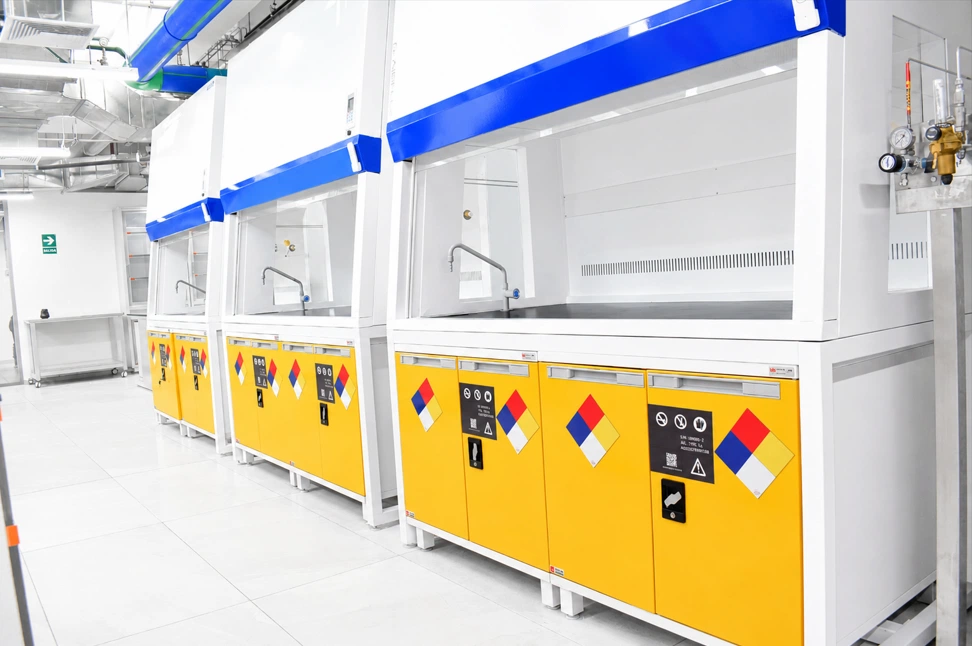
Fume Cupboards

⭐⭐⭐⭐⭐ 4.5 / 5 | Google reviews for norlab.com.au

The Norlab Fume Cupboards offer the highest level of operator protection that your laboratory requires for handling hazardous chemicals and volatile substances:

• Containment
Our fume cupboards capture every particle, vapour, and toxic emission before it reaches your team. Consistent face velocity and optimal airflow control across the entire work surface — so your operators work with confidence, not risk.

• Customisation
Our fume cupboards can be customised in width, sash configuration, liner material, plumbing fixtures, and ventilation setup to match the specific chemical processes and bench layout of your laboratory, available in galvanised steel, cold-rolled steel, HPL phenolic, and polypropylene construction across three size options.

• Compliance
Our fume cupboards meet SEFA 1, AS/NZS 2243.8 and ISO 9001 standards, ensuring your laboratory passes every face velocity test and stays fully compliant with ventilation safety regulations from day one.

Fume Cupboards Specifications

High-quality Airflow

High-quality Airflow

Gas and Water Valves

Gas and Water Valves

Waterproof Plug

Waterproof Plug

LCD Control Panel​

LCD Control Panel​

Sash Position Sensor

Sash Position Sensor

Optimal Space 

Underbench Space

Norlab fume cupboards are engineered using galvanised steel, cold-rolled steel, HPL phenolic, or polypropylene construction — paired with a phenolic resin benchtop resistant to acids and aggressive chemicals. A transparent acrylic sash provides full visibility of the work surface, while optional under-bench safety cabinets deliver up to 60 minutes of fire-resistant protection for chemical storage below. Every unit is manufactured under strict Australian quality standards and designed to maintain consistent airflow containment, protecting laboratory personnel from hazardous fumes, vapours, and particulates during daily operations.

Fume Cupboards Comparison Table

Fume Cupboards​ Fume Cupboards​ Fume Cupboards​ Fume Cupboards​

Reference

F-Airflex | Galvanised Steel

A-Airflex | Galvanised Steel

G-Airflex | Phenolic Resin

P-Airflex | Polipropylene

Available Sizes​

1200 mm (47″)
1500 mm (59″)
1800 mm (71″)

1200 mm (47″)
1500 mm (59″)
1800 mm (71″)

1200 mm (47″)
1500 mm (59″)
1800 mm (71″)

1200 mm (49″)
1500 mm (60.9″)
1800 mm (72.7″)

External Dimensions:
(Width × Depth × Height)

1200″ x 800″ x 1400″

1200″ x 800″ x 2300″

1200″ x 800″ x 2300″

1245″ x 800″ x 1420″

Interior Dimensions:
(Width × Depth × Height)

1050″ x 690″ x 750″

950″ x 550″ x 2050″

980 x 690″ x 760″

986″ x 500″ x 700″

Air Velocity

0.6 – 1.3 m/5

0.6 – 1.3 m/5

0.6 – 1.3 m/5

0.3 – 0.8 m/5

Product Certifications with Australian Standards

• SEFA 1
Performance standard developed by the Scientific Equipment and Furniture Association (SEFA) for laboratory fume cupboards and ventilated enclosures. Establishes requirements for design, construction, airflow performance, containment effectiveness, structural integrity, operational safety, and long-term reliability. Provides testing and evaluation criteria to assess the ability of fume cupboards to safely contain hazardous vapours, fumes, gases, and airborne contaminants generated during laboratory procedures. Widely referenced by laboratory planners, architects, manufacturers, research institutions, pharmaceutical facilities, healthcare organisations, educational laboratories, and industrial testing environments requiring high-performance laboratory ventilation systems.

• AS/NZS 2243.8
Australian and New Zealand laboratory safety standard covering the selection, installation, operation, testing, and maintenance of laboratory fume cupboards. Establishes requirements for containment performance, airflow management, operator protection, hazard control, inspection procedures, and safe handling of hazardous chemicals within laboratory environments. Widely referenced by research laboratories, universities, healthcare facilities, pharmaceutical manufacturers, industrial testing centres, and educational institutions throughout Australia and New Zealand to support safe laboratory operations and minimise exposure to hazardous airborne contaminants.

• ISO 9001
International quality management standard published by the International Organization for Standardization (ISO). Establishes requirements for a documented Quality Management System (QMS) focused on consistent manufacturing processes, quality assurance, customer satisfaction, continuous improvement, and product traceability. For laboratory fume cupboards, ISO 9001 certification demonstrates that manufacturing operations follow recognised quality management practices designed to ensure consistent product quality, reliable performance, manufacturing precision, and compliance with customer and regulatory requirements across laboratory, healthcare, educational, pharmaceutical, and industrial applications.

Product Gallery

Success Stories

 Since installing the Airflex Series, airflow has been consistent and predictable. Operators immediately felt safer, and our internal safety assessments showed measurable improvement in containment performance. ⭐⭐⭐⭐⭐

 The Airflex fume cupboards gave us confidence that we weren’t just meeting minimum requirements, but genuinely protecting our staff. The reduction in turbulence and the smooth airflow made a visible difference during day-to-day work. ⭐⭐⭐⭐⭐

Frequently Asked Questions

Not all fume cupboard models are equally suited for every process, and selecting the correct Airflex model for your application is one of the most important decisions in the specification process. The A-Airflex and F-Airflex fume cupboards are designed for routine chemical operations such as light acid digestions, vapour and gas extraction, and chemical transfers including pipetting. These models are ideal for applications involving low to moderate concentrations of chemical fumes and vapours.

The G-Airflex and P-Airflex fume cupboards are designed for more demanding chemical processes, including prolonged acid digestions and complex chemical reactions that generate higher concentrations of corrosive fumes. Their construction and airflow design make them better suited for handling aggressive acidic environments and continuous chemical processing. The right model for your specific application is determined during the design consultation based on the chemicals involved, the work procedures, and the laboratory’s ventilation requirements.

No, fume cupboards and laminar flow cabinets serve fundamentally opposite purposes and cannot substitute for each other. Fume cupboards are designed to protect the operator: they capture hazardous vapours, fumes, and gases generated inside the hood and exhaust them away from the user.

The airflow moves from the room toward the operator and then into the hood, creating a barrier between the work and the person. Laminar flow cabinets are designed to protect the product or sample from contamination: HEPA-filtered air flows either horizontally toward the operator or vertically downward over the work surface, creating a clean particle-free environment inside the cabinet.

Using a laminar flow cabinet instead of a fume cupboard when working with hazardous chemicals exposes the operator directly to vapours being pushed outward by the clean airflow — a serious safety hazard. If your process requires both product protection and operator protection simultaneously, that requires a biological safety cabinet (BSC Class II), not either a fume cupboard or a laminar flow cabinet alone.

Norlab Airflex fume cupboards are engineered to meet SEFA 1 performance criteria for laboratory fume hood containment, along with applicable AS/NZS 2243.8 requirements for installation, operation, testing, and maintenance of laboratory fume cupboards. Manufacturing is supported by an ISO 9001 certified quality management system to ensure consistent product performance, reliability, and traceability.

After installation, fume hood performance should be verified before initial use with a face velocity measurement in accordance with site safety procedures and applicable laboratory ventilation requirements. Ongoing performance verification — including face velocity checks — should be conducted annually at minimum, or after any relocation, duct modification, or HVAC system change. Many regulated facilities (pharmaceutical GMP, university research laboratories, and accredited testing environments) require more frequent verification. Norlab provides technical documentation to support initial commissioning and ongoing compliance records.

Face velocity is the single most critical safety parameter in any fume hood. If it’s too low (below 0.3 m/s), hazardous vapours can escape the hood and reach the operator’s breathing zone. If it’s too high (above 0.5 m/s), turbulent airflow creates vortices that pull contaminants out of the containment area.

Norlab Airflex fume cupboards are engineered with optimised airflow geometry to maintain consistent face velocity (typically 0.3–0.5 m/s) across the entire sash opening, ensuring reliable operator protection without creating disruptive turbulence inside the work chamber. The aerodynamic sash design and internal baffles work together to deliver smooth containment regardless of sash height position.

Fume cupboards are among the most energy-intensive equipment in any laboratory — a single conventional hood running 24/7 can consume as much energy as 3.5 average Australian homes annually, primarily due to the conditioned air it exhausts from the building. This makes operating cost a major factor for facilities with multiple hoods.

Norlab Airflex fume cupboards incorporate airflow optimisation features that reduce energy consumption while maintaining full containment performance. The efficient internal baffle system and aerodynamic design minimise the total exhaust volume required to achieve safe face velocities, translating to measurable HVAC savings over the hood’s operational lifetime — particularly impactful for laboratories operating multiple units simultaneously.

Trust the Professionals.

+ 1000 Labs Manufactured & Installed in Australia and Worldwide.

Australia Map

Your lab’s fume protection solved — engineered to your exact airflow and safety requirements.

Tell us what you’re working with and we’ll recommend the right fume hood type, sash configuration, and ventilation setup — at no cost, no obligation.

🎯 Expert guidance included — free 3D design
Our lab safety specialists review your project personally.

✍🏼 Fully custom — width, sash type, liner, plumbing fixtures
Fume Cupboards built around your chemical processes and layout.

📌 Australian owned & operated — nationwide delivery
Manufactured and supported from Victoria.