
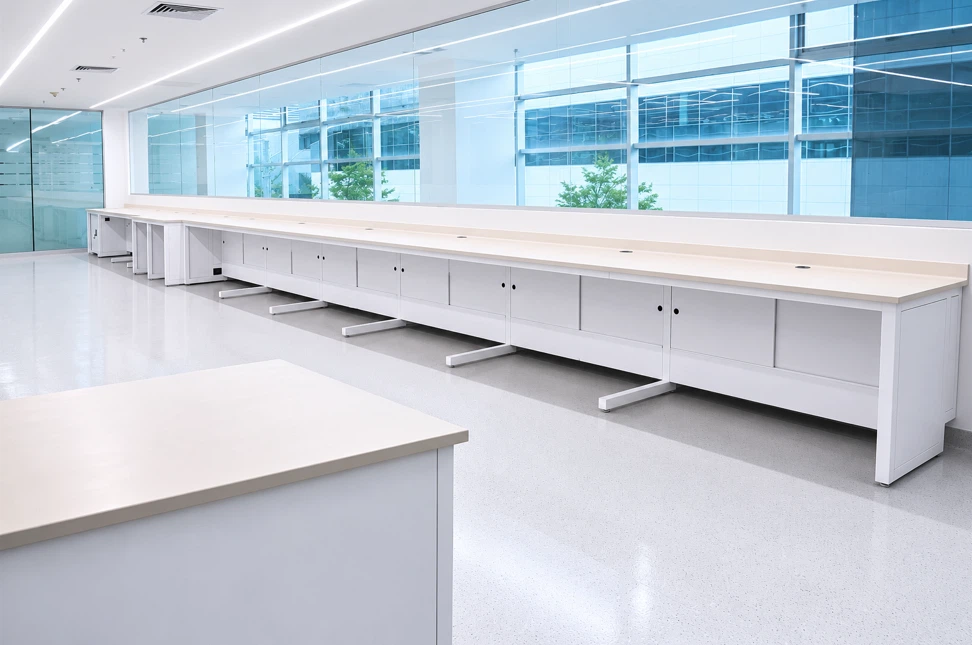
In This Article, You’ll Learn: how acrylic benches offer a unique advantage in laboratory infrastructure by being fully repairable and renewable, significantly extending their lifespan and reducing the long-term Total Cost of Ownership (TCO).
When making significant capital investments in laboratory infrastructure, the focus is often on initial cost and immediate performance. However, savvy Lab Managers and Project Directors look beyond the purchase price to the long-term value—the Total Cost of Ownership (TCO). In this analysis, acrylic benches emerge as a remarkably smart investment. Unlike materials that must be fully replaced when damaged, acrylic surfaces possess a unique, renewable quality that ensures your work surface remains pristine and functional for decades, transforming a simple purchase into a sustainable, long-term asset.
The defining feature of acrylic benches is their ability to be seamlessly repaired. Scratches, minor chips, and even burn marks—inevitable occurrences in a busy lab—do not necessitate a costly replacement of the entire bench. Instead, the damage can be easily sanded and polished out, restoring the surface to its original, flawless finish.
This repairability is a massive advantage for lab operations:
• Minimised Downtime: Repairs can often be performed in-situ and quickly, minimising disruption to critical research.
• Aesthetic Integrity: Maintains the clean, professional appearance of the lab, which is crucial for client and regulatory visits.
• Reduced Waste: Supports sustainable lab practices by eliminating the need to discard entire sections of bench due to localised damage.
The longevity of acrylic benches is further enhanced by their construction. The material can be joined with an adhesive that creates a virtually invisible and non-porous seam. This seamless integration is a critical feature for hygiene, especially in clinical, biotech, and food testing laboratories.
The absence of visible seams, gaps, or pores eliminates potential harbors for bacteria, fungi, and chemical residues, ensuring a surface that is easy to clean and sterilise. This non-porous nature is essential for maintaining compliance with strict Australian health and safety standards, providing confidence that the work surface will not contribute to cross-contamination.
The term (renewable) in the context of acrylic benches refers to the ability to resurface the material. Over time, even the most durable surfaces can show signs of wear. Acrylic can be completely sanded down and refinished, effectively giving the bench a (new life) without the expense of a full replacement. This renewability drastically extends the functional life of the bench, making it a truly sustainable choice that aligns with modern environmental and fiscal responsibility goals.
Choosing acrylic benches is a strategic decision that prioritises long-term value over short-term savings. The unique combination of seamless hygiene, full repairability, and renewability ensures that your laboratory infrastructure remains compliant, aesthetically pleasing, and functionally superior for decades. Invest in the surface that is designed to be repaired, not replaced.
Acrylic benches have limited chemical resistance: they handle sodium hypochlorite (standard hospital-grade disinfection), quaternary ammonium, 3% hydrogen peroxide, and mild detergents without issues. What damages them permanently: acetone, 100% isopropanol left in prolonged contact, chlorinated solvents, and concentrated formaldehyde. 70% ethanol is generally tolerated for quick disinfection wipe-downs but shouldn’t be used as a routine cleaner.
In practical terms: acrylic works well in clinical, diagnostic, or life sciences laboratories where organic solvents aren’t part of the workflow. In analytical chemistry or synthesis environments, it’s a non-starter.
Acrylic benches start to soften at around 70–80°C, making them the most heat-sensitive of the four materials. A beaker of boiling water set directly on them can leave a permanent mark within seconds. A hot plate is completely incompatible. That’s not a dealbreaker in the right context — clinical and diagnostic laboratories that don’t use direct heat sources will never run into this. But it’s an immediate disqualifier for any space with heating equipment on the bench.
A well-maintained acrylic bench lasts 10 to 20 years. The biggest factor in how long it lasts is how it gets cleaned: using the wrong cleaning products is the number-one cause of premature failure. In laboratories where the material’s limitations are respected, the durability is perfectly adequate. Acrylic is actually the one material where user behaviour has the biggest direct impact on lifespan, depending on how it’s treated day to day.
This is acrylic’s standout advantage over the other materials: surface scratches can be buffed out with acrylic polish or 0000 steel wool and left looking practically new. Deeper damage — cuts, light burns — can be addressed with progressive wet sanding from 400 to 1200 grit, followed by polishing. It’s the only benchtop material you can restore in the field multiple times over its service life without replacing the piece. For laboratories where a clean, professional appearance matters and the maintenance budget exists, that’s a real selling point.
Installation is similar to the others, but there are two things to get right: first, joints must be sealed with a silicone that’s compatible with acrylic — solvent-based sealants can attack the material. Second, whoever cleans the laboratory needs to know what products to avoid, because a one-time mistake with an incompatible solvent can cause permanent damage. Unlike epoxy or ceramic — where an occasional cleaning error is a minor issue — with acrylic it can be irreversible. A short written cleaning protocol posted in the laboratory is worth more than any maintenance contract.
Looking for a personalised quote on laboratory design or customised laboratory furniture?
We support your projects with fully managed design & manufacturing solutions, ensuring every detail aligns with your workflow, safety needs, and performance requirements.
Expert guidance included — free 3D design
Our lab safety specialists review your project personally.
Fully custom — material, dimensions, configuration & finish
Furniture designed around your lab’s workflow, space constraints, and compliance requirements.
Australian owned & operated — nationwide delivery
Manufactured and supported from Victoria.