
In This Article, You’ll Learn: how certified mobile shelving transforms static storage into a dynamic, high-density system, effectively doubling your laboratory’s capacity and optimising the physical flow of research assets.
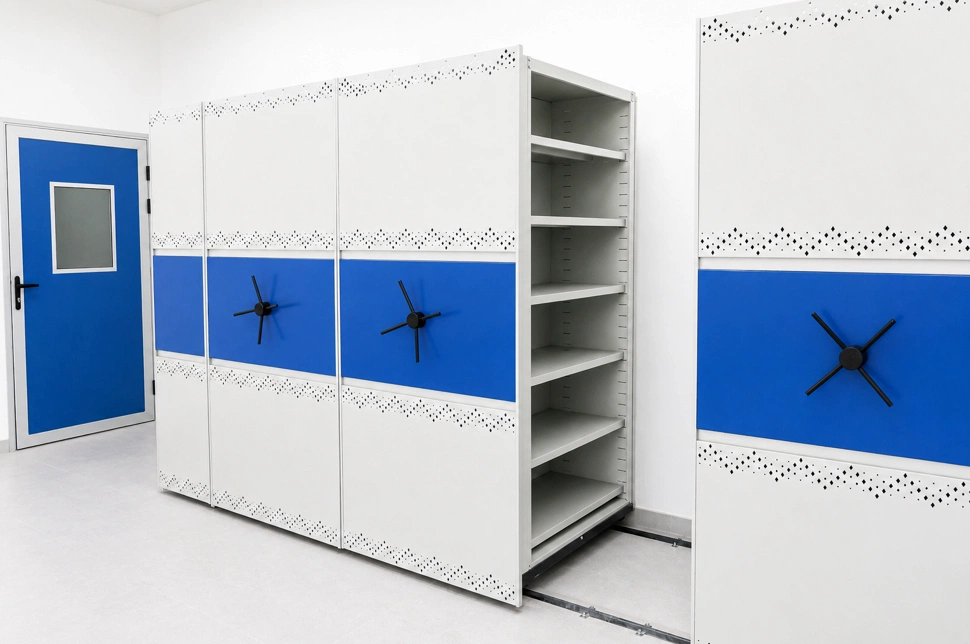
In modern Australian laboratories, space is the most expensive and finite resource. Every square meter must be justified by its contribution to research and efficiency. Traditional, static shelving systems are a major culprit of wasted space, creating redundant aisles that consume valuable real estate. mobile shelving is the strategic answer to this challenge. By mounting shelving units on a smooth track system, shelving eliminates all but one working aisle, consolidating storage into a high-density footprint. This is not just a storage upgrade; it is a fundamental redesign of your laboratory’s physical logistics, directly translating unused aisle space into functional, productive laboratory area.
The most compelling argument for mobile shelving is its financial return on investment (ROI). In a high-cost real estate market, doubling the storage capacity within the existing footprint is equivalent to gaining a significant amount of new laboratory space without the cost of construction or leasing. This strategic efficiency allows institutions to defer costly expansions or to maximise the utility of their current facility.
• Cost Avoidance: By consolidating storage, laboratories avoid the expense of building new wings or renting additional facilities.
• Long-Term Savings: Reduced overhead costs from energy, cleaning, and maintenance of larger spaces.
• Asset Value: Facilities equipped with modern storage solutions increase their long-term property value.
The investment in shelving storage is quickly offset by the avoided costs of new construction, making it one of the most fiscally responsible infrastructure decisions a Lab Manager can make. In addition, maximising storage capacity directly translates into financial resilience, as laboratories can accommodate growth without incurring new property expenses.
Beyond space saving, mobile shelving dramatically improves workflow efficiency. The system replaces the time-consuming search process with a controlled, organised retrieval method. Because the units are built with full-extension access and a secure, smooth track system, personnel can quickly and safely access materials.
• Faster Retrieval: Items are stored in a logical, compact manner, reducing wasted time.
• Inventory Accuracy: Clear organisation supports precise stock control.
• Reduced Errors: Misplacement and duplication are minimised through structured layouts.
Furthermore, the high-density nature encourages a more rigorous inventory management system. When every item has a designated, easily locatable spot, the time lost to searching, misplacing, or duplicating orders is drastically reduced, allowing researchers to focus on their core scientific tasks. This efficiency is directly tied to maximising storage capacity, as organised systems ensure that every shelf is used to its full potential, eliminating wasted space and wasted effort.
In a high-density storage environment, security and safety are paramount. mobile shelving systems are engineered with features that enhance both.
• Centralised Locking: A single mechanism secures the entire system, protecting sensitive materials.
• Structural Integrity: Heavy-duty construction prevents collapse or instability under high loads.
• Controlled Access: Restricted entry ensures compliance with safety and confidentiality standards.
The ability to lock the entire system with a single mechanism protects sensitive materials, valuable equipment, and confidential documents from unauthorised access. The robust, heavy-duty construction (often stainless or powder-coated steel) ensures the stability of the high load capacity, preventing structural failure. This combination of physical security and structural integrity protects the stored assets, which often represent years of research and significant financial investment.
The modular nature of mobile shelving makes it an excellent future-proofing strategy. As research demands evolve, the system can be easily reconfigured, expanded, or relocated with minimal disruption.
• Adaptability: Adjustable shelving heights accommodate diverse materials.
• Scalability: Units can be expanded as laboratory needs grow.
• Relocation Potential: Systems can be moved without costly reconstruction.
Unlike fixed storage, shelving storage provides the flexibility to adapt to changing inventory needs—from large equipment to small samples—by simply adjusting the shelving height and layout. This adaptability ensures that the storage infrastructure can support the laboratory’s growth and changing scientific focus for decades to come. Future-proofing is inseparable from maximising storage capacity, as laboratories must plan not only for current needs but also for the inevitable expansion of research activities.
Mobile shelving is a strategic laboratory asset that solves the critical challenge of space and efficiency. By converting wasted aisle space into productive storage, optimising workflow, and providing superior security, it delivers a clear ROI and future-proofs your facility. Choose high-density shelving storage to unlock the full potential of your laboratory’s physical capacity. Ultimately, maximising storage capacity is not just about fitting more items into a smaller footprint—it is about enabling innovation, protecting valuable assets, and ensuring that laboratories remain agile in the face of evolving scientific demands.
Traditional shelving systems require fixed aisles between every shelving unit, which can consume a significant portion of available floor space. Mobile shelving eliminates unnecessary aisles by allowing shelving units to move along a track system, creating access only where needed.
As a result, laboratories, archives and storage facilities can often increase storage capacity by 50% or more within the same footprint. This allows organisations to maximise existing space without the expense and disruption of facility expansions or relocations.
Mobile shelving is widely used in laboratories, universities, hospitals, museums, government archives and industrial facilities where storage space is at a premium. It is particularly valuable in environments that require organised storage of documents, laboratory consumables, samples, equipment or archived records while maintaining easy access to stored materials.
Facilities facing growth constraints often use mobile shelving systems to accommodate increasing storage demands without sacrificing valuable operational space.
Yes. Mobile shelving can be configured to support a wide variety of laboratory storage requirements, including chemicals, glassware, consumables, samples, instruments and documentation. The system can be customised with adjustable shelves, lockable compartments, pull-out trays and specialised storage accessories to suit specific laboratory workflows.
When properly designed, mobile shelving improves organisation, protects stored materials and helps laboratories make more efficient use of available floor space.
Modern mobile shelving systems incorporate multiple safety features designed to protect both users and stored materials. These may include anti-tip mechanisms, aisle locking systems, mechanical safety stops and ergonomic operating controls that prevent accidental movement while an aisle is occupied.
High-quality systems are engineered to support substantial loads while maintaining smooth and reliable operation, making them suitable for demanding laboratory, healthcare and industrial environments.
Yes. The design of mobile shelving systems should consider factors such as floor loading capacity, accessibility requirements, fire safety planning, operational workflows and long-term storage growth. High-density storage systems can significantly increase storage capacity, but they must be properly engineered to ensure safe operation and efficient access to stored materials.
Organisations planning large-scale storage projects can refer to guidance published by the National Archives of Australia, which outlines best practices for storage environments and records management. Additional information on shelving design and storage planning can also be found through Standards Australia and the International Council on Archives (ICA).
Reviewing these resources alongside operational requirements helps organisations implement Mobile Shelving systems that maximise storage density while maintaining safety, accessibility and long-term functionality.

Looking for a personalised quote on laboratory design or customised laboratory furniture?
We support your projects with fully managed design & manufacturing solutions, ensuring every detail aligns with your workflow, safety needs, and performance requirements.
 Expert guidance included — free 3D design
Our lab safety specialists review your project personally.
 Fully custom — material, dimensions, configuration & finish
Furniture designed around your lab’s workflow, space constraints, and compliance requirements.
 Australian owned & operated — nationwide delivery
Manufactured and supported from Victoria.