
In This Article, You’ll Learn: how epoxy benches deliver proven protection through chemical inertness, non-porous construction, and long-term durability in demanding laboratory environments.
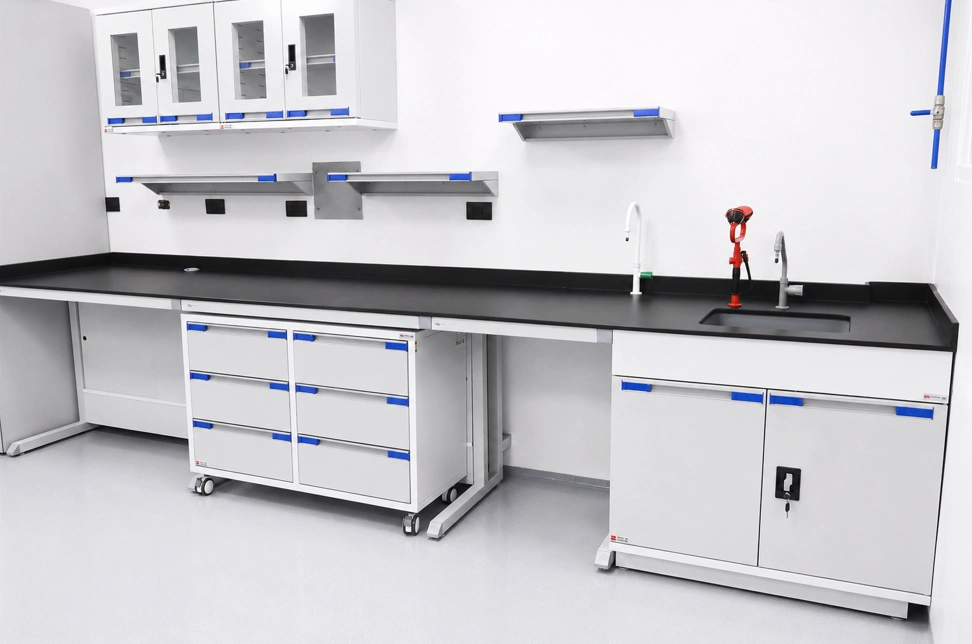
In a high-performance laboratory, chemical exposure is not a hypothetical risk it is part of daily operation. The real value of a work surface lies in its ability to protect the lab environment consistently over time, without reacting, degrading, or compromising safety. epoxy benches deliver this level of reliability by providing proven protection against aggressive chemicals, contamination, and long-term wear. Choosing the right bench surface is not a design decision, it is a safeguard for laboratory integrity, personnel safety, and data accuracy.
Laboratories that work with strong acids, alkalis, and organic solvents rely on epoxy benches because their performance is inherent to the material itself. Protection is not applied as a coating or finish it is engineered into the structure, ensuring predictable behavior under constant chemical exposure.
Chemical inertness means a surface remains stable when exposed to reactive substances, without initiating chemical reactions or surface degradation. epoxy benches achieve this through a tightly cross-linked resin structure that resists chemical penetration and molecular interaction. When aggressive reagents come into contact with the surface, the material remains unchanged, preserving both its physical properties and the controlled laboratory environment.
This inert behavior delivers several critical advantages:
• Prevents surface etching, swelling, or discoloration caused by acids and solvents
• Eliminates chemical interactions that could compromise experimental results
• Maintains consistent performance even after repeated spill events
Because epoxy benches do not rely on surface treatments, their chemical resistance does not diminish over time, making them a dependable solution for laboratories with continuous exposure to corrosive substances.
Porosity is one of the most underestimated risks in laboratory surfaces. Microscopic pores allow chemicals, liquids, and biological agents to penetrate beneath the surface, where they become impossible to remove. epoxy benches are manufactured as a solid, non-porous material, forming a continuous barrier that prevents absorption at every level.
This characteristic is essential in laboratories where hygiene and contamination control are critical:
• Spills remain on the surface and can be fully removed during cleaning
• No hidden reservoirs for bacteria, solvents, or residues
• Reduced risk of cross-contamination between experiments
Because epoxy benches are seamless and monolithic, they support rigorous cleaning protocols without material degradation. This makes them especially suitable for pharmaceutical, medical, and microbiology laboratories where surface integrity directly impacts compliance and safety.
While chemical protection is the defining feature, epoxy benches are also engineered to withstand physical and thermal stress common in active laboratories. During manufacturing, the material is cured under controlled heat and pressure, creating a dense structure with exceptional mechanical stability.
This process provides additional layers of protection:
• Resistance to thermal shock from rapid temperature changes
• Tolerance to high temperatures without warping or cracking
• High impact strength for daily laboratory use
The combination of chemical inertness, non-porosity, and structural durability ensures that epoxy benches perform reliably in environments where failure is not an option. Their longevity reduces maintenance, replacement costs, and operational disruption.
Laboratory safety and performance depend on surfaces that actively protect the working environment. epoxy benches provide proven protection through chemical inertness, non-porous construction, and long-term durability. By selecting this material, laboratories secure a stable foundation that supports safety protocols, preserves data integrity, and performs consistently in the most demanding conditions.
Epoxy benches have the best chemical resistance available in a standard laboratory benchtop: they handle concentrated HCl, H₂SO₄ up to around 50%, and most common bases and organic solvents without issue. The real limits are concentrated HNO₃ (above 50%) and strong oxidising mixtures — aqua regia, piranha solution — especially at elevated temperatures, where prolonged exposure will eventually degrade the surface. The practical rule: epoxy is your best option for demanding daily chemistry, but that doesn’t mean you leave a puddle of concentrated nitric acid sitting on it for hours. Clean up spills immediately, no matter what material you have.
Epoxy benches handle up to 180–200°C for brief contact without warping, which makes them more heat-tolerant than phenolic. A magnetic stir plate running at 150°C set directly on it is generally fine for normal use periods. What does cause permanent damage is direct flame contact or sustained exposure above 200°C. For laboratories that regularly use Bunsen burners or high-intensity heating equipment on the bench surface, ceramic is still the only material with no real heat restrictions.
Under normal laboratory conditions, expect 20 to 30 years. Lifespan shortens if you’re regularly working with concentrated oxidising solvents without prompt clean-up, or in environments with extreme thermal cycling. It extends in laboratories with moderate use and consistent cleaning habits. Like phenolic, the most common failure point isn’t the surface — it’s the perimeter joints. An epoxy top with well-maintained sealant lasts decades; one with deteriorated joints starts failing from the edges inward.
Minor surface damage — shallow scratches, small chips — can be repaired with a two-part epoxy filler in a matching colour. It’s functional, though not invisible. A deep crack that goes through the full thickness can’t be repaired to an acceptable finish because the filler will never match the original surface exactly. If the damage is significant or covers a large area, the honest answer is to replace that section.
The surface itself is genuinely maintenance-free: no waxing, no sealing, no periodic treatments. Regular cleaning with a mild detergent and water covers daily use. The only thing that needs periodic attention are the silicone or polyurethane sealant joints at edges, sinks, and walls — inspect them every 3 to 5 years and reapply sealant when you see deterioration. One common mistake is using abrasive cleaners or steel wool pads that scratch the surface over time.

Looking for a personalised quote on laboratory design or customised laboratory furniture?
We support your projects with fully managed design & manufacturing solutions, ensuring every detail aligns with your workflow, safety needs, and performance requirements.
 Expert guidance included — free 3D design
Our lab safety specialists review your project personally.
 Fully custom — material, dimensions, configuration & finish
Furniture designed around your lab’s workflow, space constraints, and compliance requirements.
 Australian owned & operated — nationwide delivery
Manufactured and supported from Victoria.